
















What actually happens between deciding to buy and the coins being yours
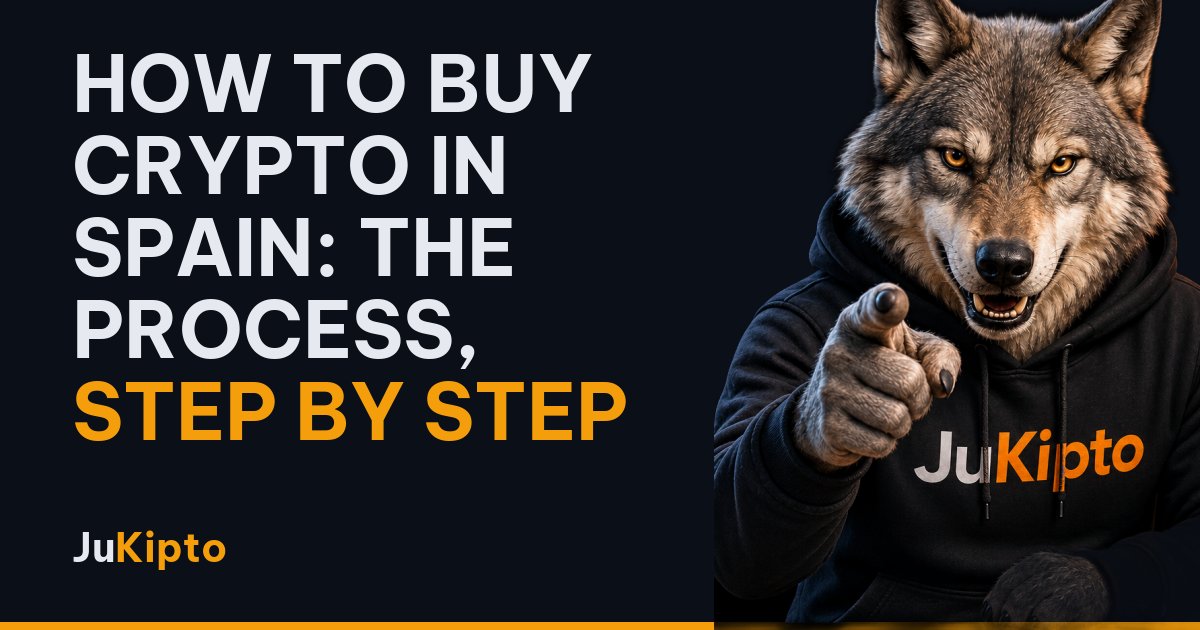
How to buy crypto in Spain: the process, step by step
Short answer: work out first how much you could lose in full, and only then where and what. The order is: the amount, a platform authorised under MiCA — the EU crypto-assets regulation — and listed on the register kept by ESMA, the European Securities and Markets Authority; identity verification; funding by SEPA transfer from your Spanish bank, cheaper than a card; the purchase; and a withdrawal to your own wallet if the sum would hurt to lose. Keep a record of every transaction.
Almost everybody does this in the wrong order. First they pick the coin — usually the one they half-remember from a headline — then they look for somewhere to buy it, and only at the end, if at all, do they ask themselves how much they are going to put in. That order explains most of the unhappy endings: when you decide the amount last, the amount is decided by enthusiasm.
The order that works is the other way round. How much, where, and only then what.
First: how much, and over what horizon
The question is not "how much do I want to make" but "how much could I lose in full without it changing my month". It sounds like a textbook line and it is meant literally: the assets we are talking about move 10% in a day without anything special happening, and they have fallen more than 70% from their highs on several occasions without ceasing to exist.
If that figure is zero, you have finished this guide and you got it right. If it is a small number, start there and do not raise it until you have been through a full cycle up and back down. You will learn more from a 40% drop with a hundred euros inside than from any article, this one included.
And there is one decision worth taking now, while you are calm: when you would sell. Write it down. Nobody decides well at three in the morning on a Tuesday with the screen in the red.
Second: where — and this one does have an objective answer
Since 1 July 2026, only platforms authorised under MiCA and listed on the ESMA register may provide services in Spain. This is not a recommendation of ours: it is who may legally operate here and who may not.
That register is public, and we keep it mirrored in the list of providers authorised in Spain, updated daily from the official source. If a platform is not on it, nothing else matters — however good its fees look, and however many followers the person advertising it has.
Among the ones that are on it, the choice comes down to preference and cost. We compare them in the exchange comparison, with what each charges and the sort of user it suits.
Identity checks: why they ask for your DNI
You are going to have to send in your identity document — the DNI, Spain's national ID card, or the passport or residence card you identify yourself with here — plus a selfie and, nearly always, proof of address. A lot of people stop here, assuming it is a whim of the platform. It is not: it is a legal anti-money-laundering obligation, and a platform that does not ask you for it is exactly the one you should be avoiding.
It is usually settled in minutes, though it can take days if there is a queue or if the photo comes out badly. Two tips that save a week: take the photos in natural light, no flash, and use exactly the same name that appears on your bank account. A second surname that does not match — Spanish names carry two — is the number one reason for rejection.
Use that dead time to turn on two-factor authentication with an app, never by SMS. An SMS can be hijacked by cloning your SIM, and it is not unusual. It is the difference between a fright and a loss.
Putting euros in: transfer or card, and it does matter
There are two routes, and there is a fair amount of money between them.
- SEPA transfer. An ordinary euro transfer from your Spanish bank. Free or nearly free on most platforms. It takes anywhere from a few hours to a couple of working days the first time, and after that it is usually a matter of hours.
- Card. Instant, and that is where the catch is: you pay between 2% and 3% for the convenience. On a €1,000 purchase that is €20 or €30 given away before you start.
The first time, the card is tempting because you want to see the thing work. If you need to check, do it with twenty euros and then send the rest by transfer.
The first purchase: which button, and what they really charge
Nearly every platform has two interfaces: a simple one, with a big buy button, and an advanced one with a chart and an order book that puts people off. The simple one charges more. Sometimes a great deal more, and not always in the form of a fee: they take it in the spread, the gap between the price they sell to you at and the real market price. You cannot see it there, and that is why it works.
It is worth spending ten minutes understanding the advanced interface, even if you are only ever going to use two things in it:
- Market order: buy now, at whatever price is there. Simple, and enough for small amounts in liquid coins.
- Limit order: buy only if the price reaches X. It may take a while, or never execute at all, but you set the price.
If the coin you want has little volume, a market order can fill considerably worse than the screen suggested. That is another argument for starting with the big ones: you can see the price and the market depth of each on its own page — Bitcoin, for instance.
And now, where do they sit?
When the purchase goes through, your coins are on the platform. That means the platform is holding them, not you. For small amounts, and while you are learning, that is reasonable. For amounts that would hurt to lose, it is not.
The alternative is to withdraw them to your own wallet, where you hold the keys. That has a risk of its own — lose the recovery phrase and there is no customer service that can save you — and it is worth understanding the difference properly before you move anything: we explain it in hot wallets and cold wallets and in the security guide. If what you want is a device, the real choice is between two manufacturers, and we have put them side by side in Ledger or Trezor, with data you can check and no invented scores.
One detail that reassures a lot of people: moving your coins to your own wallet is not selling them. There is no disposal, so there is no tax. What changes is who is holding them, not whose they are.
What to keep from the first day
Here is what nobody tells you on your first purchase, and what costs most afterwards: keep a record of every transaction. Date, coin, quantity, price in euros and fee.
The reason is that in Spain every sale at a gain is taxable and — this catches almost everyone out — so is every swap of one coin for another. Swapping bitcoin for another coin is a disposal even if you have not taken a single euro out to your bank. With two transactions a year you can do it by hand; with fifty, reconstructing it two years later is not workable, and it has to be done oldest first, because the Agencia Tributaria, the Spanish tax authority, requires the FIFO method.
Platforms let you export your history as a CSV. Do it every few months and keep the file; the day you close an account or move to another platform, that file is all you have left. How all of this is taxed is set out in the guide to crypto tax in Spain, and you can work out what you would have to pay from your real history.
And when the time comes to sell — which is the day the tax authority turns up — the journey back is told here: how to sell and get the euros into your bank.
And at last the what: buying guides, coin by coin
Everything above holds whatever you buy. What comes after it does not. Which authorised platforms list a particular coin varies enormously from one to another — quite a few turn up only on sites that cannot even operate here — the risks are nothing alike between a network that is mined, an exchange's own house token and the token of a platform for launching memecoins, and the tax treatment forks the moment a coin generates rewards: the tax authority treats those not as a capital gain but as investment income, and they are declared differently.
That is why each one has its own page, written to answer that before it answers the price:
- Pump.fun (PUMP), the token of Solana's memecoin factory
- Monero: where it can still be bought from Spain
- OKB, the house token of OKX
- KuCoin and its KCS token
- UNUS SED LEO and the problem of getting hold of it from here
- Ethena (ENA), which is not the same thing as its synthetic dollar USDe
- EigenLayer and restaking: rewards that are not taxed as a gain
- Kaspa (KAS): it is mined, and that changes its tax treatment
- Chainlink (LINK), the oracles that connect contracts to the real world
- Internet Computer (ICP) and what happened to its price on day one
- MemeCore (M): a chain built for minting memes, with everything that implies
Five mistakes that cost money
- Buying because of an advert. If you found out about it through advertising, you are late by definition: somebody is paying for you to buy what they already hold.
- Putting it all in at once. Spreading the purchase over several goes does not improve your average return, but it does rule out the worst case, which is going in whole on the worst day. We go into it in the piece on DCA in crypto.
- Using the simple interface for ever. You overpay for years without noticing.
- Believing that as long as you have not turned it back into euros there is nothing to declare. It is the most expensive mistaken belief in the sector.
- Keeping the recovery phrase on your phone. A photo in your gallery is a copy in somebody else's cloud.
If you have got this far and you are still not clear on what to buy, that is a good sign — it means you have not skipped the order. Start with how to invest with a method before you pick a coin, and if you trip over an odd word, it is in the glossary.
This content is for information only and does not constitute financial or tax advice. Investing in crypto-assets can lead to the total loss of your capital.
Tags / Categories :
First steps
This article is published by the Jukipto newsroom under our editorial policy. Market data comes from CoinGecko. This is not investment advice: cryptocurrencies are a volatile asset and you can lose every penny you put in — read the financial disclaimer. Spotted a mistake? Write to info@jukipto.com and we will correct it.